

FR-4 PCB Laminate = Flame Retardant
FR-4 PCB Laminate is the most commonly used base material for printed circuit boards. The "FR" means Flame Retardant (to UL94V-0), and Type "4" indicates woven glass reinforced epoxy resin.
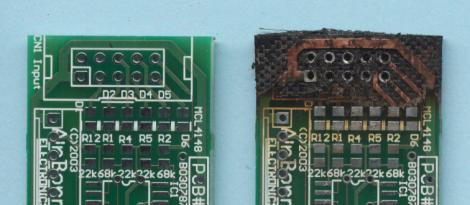
You can see our demonstration of the FR-4 rating here - we have blowtorched the PCB on the right hand side of the image. While the PCB did flame slightly, the flames extinguished themselves. Only continued application of the blowtorch would reignite the laminate. The Glass weave itself becomes clearly visible in the carbonised (burnt) circuit board. The circuit board still has some mechanical strength - it is severely degraded, obviously, but it still supports the tracks and pads. At a low voltage, surprisingly, there is little conductance across the burnt area, it might still function in a marginal sense.
While a PCB would not normally encounter a blow torch during operation, our test is a reasonable facsimile of what can happen when there is a failure in a circuit and a part overheats to the point of incinerating the surrounding board and circuitry. We have seen damage very similar to this in boards that have had these types of failures.
FR-4 is not Halogen free - that is, when igniting in an enclosed space it can potentially cause poisonous fumes. A number of companies are working on Halogen free versions of FR-4 laminate.
At the same time as we performed this test, we examined some common components - mainly to understand the concept applied to many plastics, that they may be allowed to burn, but they may not form flaming drips. One interesting anecdote: We thoroughly blowtorched a standard 0.25W 5% helical cut carbon film axial resistor; following the treatment its painted coating was just ash, the steel leads had lost their tinning, - but the resistance was still within tolerance.
The section continues with PCB prototyping
Seen on the door to a light-wave lab:
"Do not look into laser with remaining good eye."

- Contact Us
- Enquiry Form
- Sitemap
- The PCB design method
- About Circuit diagrams
- About PCB layout
- About Firmware design
- Spec'ing your job
- Our design service
- Example Projects Library
- Mechatronic control unit
- Garbage truck compactor
- RS232-RS485 convert (2006)
- Tone generator test project
- RS485 fire panel int.
- Front panel switches( A/D)
- Serial to IRDA
- Danfoss loop tester
- RAN Multilayer trainer
- Programmable Oscillator
- Pressure sense PCB
- Nursecall overdoor light V2
- Design step-by-step
- Circuit diagrams
- PCB Layout
- PCB Etching
- Prototyping
- Firmware design
- Documentation
- Manufacturing
- Economies of scale
- Test Procedures
- ECOs - changes
- EMI & ESD in design
- FR4 and fire resistance
- Project Specifications
- Specification Intro.
- Writing a Spec
- Tech Ingredients
- Example Specs (older)
- Selecting a designer
- R&D Economics
- Design Inspiration
- Autotrax Utitilities
- Autotrax links
- Our PicoBus IO Std
- RS232 connectors
- Our RS485 converter
- P89LPC932
- Our Program header
- How to use a Multimeter
- Our Site index
- Offsite Links (15000+)
- Google search
- Contact
©2013 AirBorn - Last updated 01 May 2013